













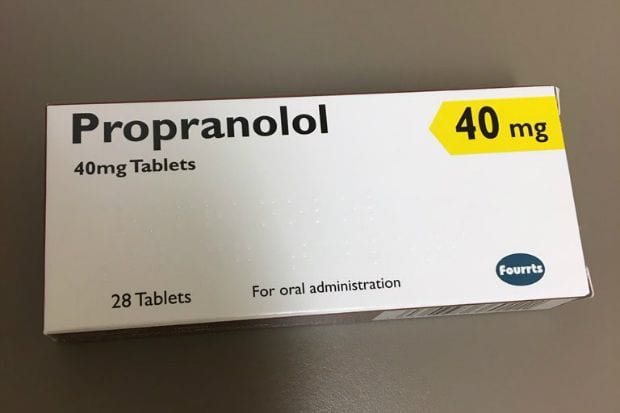
I’ve had a growing number of people ask me if propranolol can help with relieving opiate withdrawal symptoms. Thus, I decided to do some in-depth research to find out the answer.
Now that I’ve studied this prescription medication and looked for studies on it, I’ve found out some interesting things.
After studying the main mechanism of action, in theory, propranolol might be helpful for relieving opiate withdrawal symptoms.
However, I would never use this medication as a stand-alone treatment method for withdrawal.
But used in combination with other more powerful medications for withdrawal, it may offer some benefits.
Additionally, where I see the most possible benefits is down-the-line after a person has gotten off opioid drugs.
It appears to be effective for anxiety and PTSD, which are two disorders that often lead to opioid relapse.
So read on to learn how propranolol works and how it may offer you some benefits…
Propranolol Overview
Propranolol (brand name Inderal among others) is a prescription medication in a class of drugs known as beta blockers. It was developed in 1964 by British scientist James W. Black.
Propranolol is most-commonly prescribed for hypertension (high blood pressure).
Though it’s also used to treat the following conditions:
- Prevent migraines
- Reduce shaking or essential tremors
- Support heart function after a heart attack
- Relieve angina (chest pain)
- Control heart rhythm in atrial fibrillation
- Help with medical conditions involving your thyroid and adrenal glands
- Anxiety
- Performance anxiety
- PTSD
- Aggressive behavior of patients with brain injury
- Phobias
- Excessive sweating
Propranolol Mechanism of Action
Propranolol is a non-selective beta blocker. It works by blocking the action of certain natural chemicals in your body. The chemicals that are blocked are epinephrine and norepinephrine (aka adrenaline and noradrenaline).
When a person takes propranolol, the medication blocks the action of these excitatory neurotransmitters.
And in doing so, the user experiences a reduction of the following:
- Heart rate
- Blood pressure
- Strain on the heart
Propranolol For Opiate Withdrawal
As I stated at the beginning of this article, many people have asked me if propranolol is effective for relieving opiate withdrawal symptoms.
In theory, it could potentially offer some benefits.
To explain how propranolol may help, I think it will be helpful to provide you with a basic understanding of the opioid withdrawal syndrome.
The Opioid Withdrawal Syndrome
The continuous use of opioids leads to tolerance and dependence. Dependence develops when the neurons adapt to the repeated drug exposure and only function normally in the presence of the drug.
When a dependent individual abruptly stops taking opioids (leading opioid-blood concentration to fall below the required level), the now opioid-tolerant central nervous system (CNS) goes haywire.
With no inhibitive stimulation to satisfy receptors, the pathways of the CNS fire signals strenuously, performing at a level much higher than pre-dependence levels.
Now the locus coeruleus responds by triggering the autonomic fight or flight response.

What results is known as the opioid withdrawal syndrome, and it’s one of the most horrific experiences an individual could ever go through.
Some of the most common symptoms of opioid withdrawal include:
- Anxiety
- Fatigue
- Insomnia
- Depression
- Diarrhea
- Achy muscles and limbs
- Teary eyes
- Runny nose
- Sneezing
- Gastrointestinal distress
- Irritability
- Hot and cold sweats and chills
- Goosebumps
- Vomiting
- Restless Leg Syndrome (RLS)
How Propranolol May Help
During acute withdrawal, the flight or flight syndrome goes into hyperdrive. This causes MASSIVE anxiety and insomnia among other symptoms.
The fight or flight response activates the release of epinephrine and norepinephrine which are stress hormones.
If you were a caveman or cavewoman and being chased by a sabertooth tiger, this huge increase in epinephrine and norepinephrine would help you flee from danger.

And when you made it to safety, within 15 minutes your parasympathetic nervous system (PSNS) would activate and relax you, as this division of the autonomic nervous system (ANS) is responsible for “rest and digest.”
But during acute opiate withdrawal, this overactive sympathetic nervous system (SNS) keeps going… and going… and going… for what seems to be a lifetime.
In theory, since propranolol blocks the action of epinephrine and norepinephrine, it seems plausible that taking propranolol during withdrawal could lessen anxiety and insomnia and perhaps some other symptoms.
I couldn’t find any studies that have shown propranolol to be effective for opiate withdrawal.
But some people have told me they’ve used it for withdrawal along with other medicines, and they believe it helped to reduce their symptoms.
How To Use Propranolol For Opiate Withdrawal
Now that you’ve learned about the mechanism of action of propranolol, you may be thinking about using propranolol for opiate withdrawal.
If you’re going to use propranolol for opiate withdrawal, please keep the following tips in mind:
- Always take propranolol under a doctor’s supervision.
- The adult dosage for propranolol is one 40 mg tablet 3x a day. You may need more or less of this to help during withdrawal.
- Only use the medication for a few days to a week during the most severe part of opiate withdrawal, as you don’t want to take the medication long-term and thus be on another drug.
- Make sure you educate yourself on the propranolol side effects and interactions before using the drug.
- Don’t use propranolol alone to treat your symptoms as you will likely still suffer, and consider using other more powerful medications for withdrawal in combination with propranolol.
- Another powerful way to use propranolol for opiate withdrawal is to combine it with this Opiate Withdrawal Supplement and CBD Oil.

Propranol For Anxiety and PTSD
If I were going through withdrawal again, I wouldn’t worry about getting prescribed propranolol and I would only use it if I already had some.
Where I think propranolol could help the most is to prevent opioid relapse.
Many people with anxiety disorders and/or PTSD often use opioids to self-medicate their symptoms, as opioids can be very effective for these.
Since propranolol blocks the action of epinephrine and norepinephrine and reduces blood pressure, it can offer anxiolytic (anti-anxiety) benefits.
Additionally, propranolol is often used for something called “performance anxiety.”
The most common fear in the world is public speaking, and many speakers use propranolol before they go up on stage.

It has proven to be very effective at reducing performance anxiety, and speakers, musicians, actors, and others have used it successfully for this reason.
Propranolol is also being investigated as a potential treatment for PTSD.
Propranolol works to inhibit the actions of norepinephrine, a neurotransmitter that enhances memory consolidation.
In one small study individuals given propranolol immediately after trauma experienced fewer stress-related symptoms and lower rates of PTSD than respective control groups who did not receive the drug.
Key Concepts
- Acute opioid withdrawal activates the fight or flight response into a hyperactive state, which is caused by the release of the stress hormones epinephrine and norepinephrine.
- Propranolol blocks the action of these neurotransmitters, which means that it may be useful in reducing anxiety, insomnia, and other symptoms of withdrawal.
- Propranolol is not considered a stand-alone treatment for withdrawal, but it may offer the best benefits when used in combination with other more powerful medications, and/or in addition to this Opiate Withdrawal Supplement and CBD Oil.
- Propranolol may be able to assist with relapse prevention as many people with anxiety disorders and/or PTSD get back on opioids to self-medicate their symptoms.
If you have any comments or questions about the use of propranolol for opiate withdrawal, please post them in the comment box below.

Leave a Reply